Misconception first: many experienced DeFi users assume that switching wallets is only about UX—tabs, themes, or a faster seed import. That’s a surface view. For someone who routes liquidity, batches approvals, or runs value-at-risk scenarios across chains, the difference between a wallet that simulates and scans transactions and one that does not is operationally material. Rabby Wallet prizes pre-transaction simulation and a security engine that reports contract risks, and that combination changes how you approach approvals, front-running risk, and cross-chain logistics.
This piece unpacks the mechanism behind those features, the trade-offs compared with mainstream alternatives (MetaMask, Trust Wallet, Coinbase Wallet), and the practical boundaries that US-based DeFi power users should know before installing, integrating, or delegating signing to Rabby.
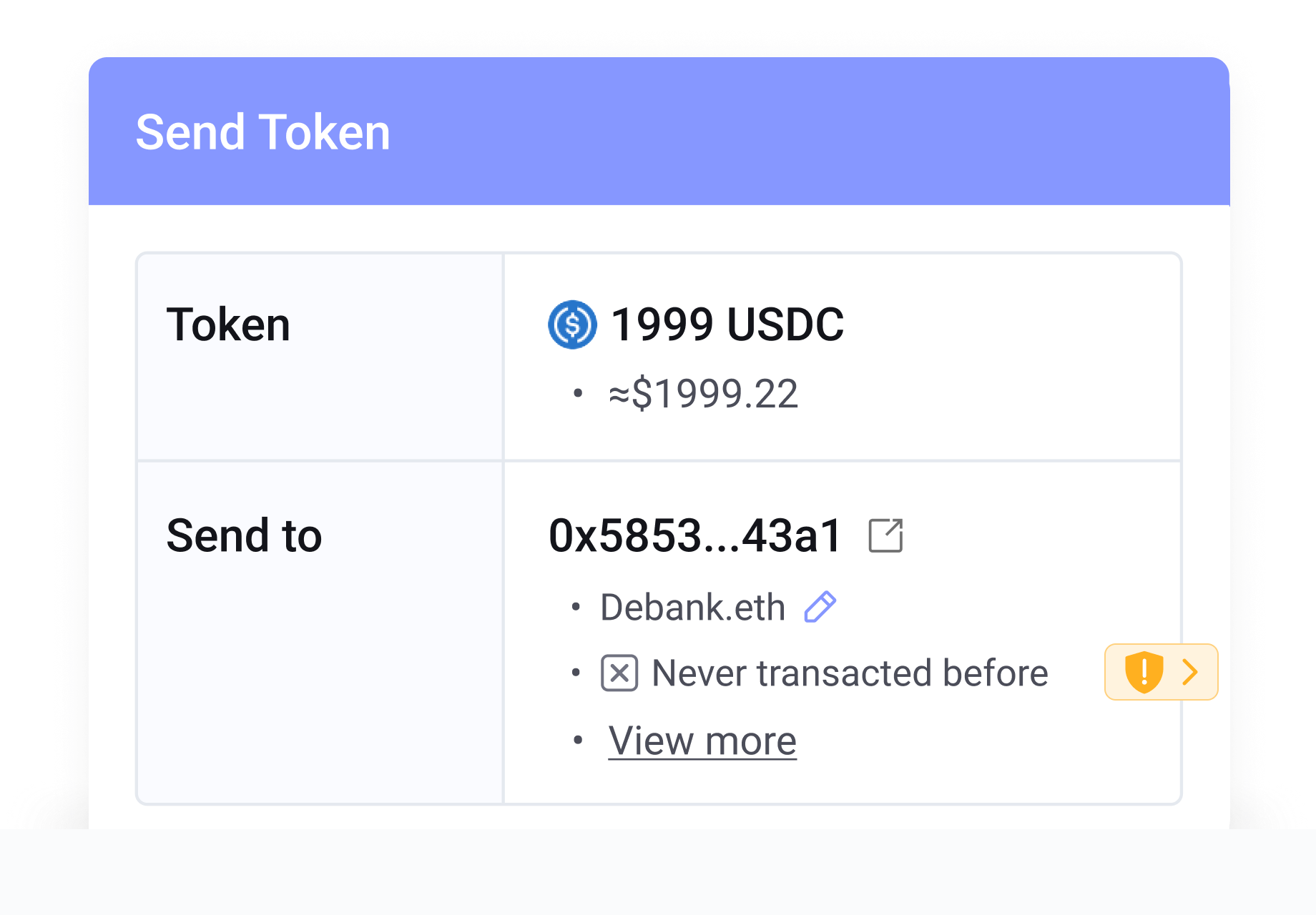
How Rabby’s transaction simulation and security engine work (mechanically)
Rabby simulates a transaction locally before you sign, computing estimated token balance deltas and gas costs. Mechanically, that involves replaying the intended call using node data or an Ethereum Virtual Machine (EVM) simulator to derive state changes without broadcasting. The wallet then passes the simulation result through a security layer that flags known-risk indicators: whether the target contract has been previously implicated in exploits, whether the approval requested would grant unlimited transfer rights, or whether the destination address resolves as an externally owned account vs. a non-existent address.
Why this matters in practice: blind signing—authorizing a complex contract call without knowing its precise state effects—is one of the most common operational vectors for losses (phishing, rogue approvals, malicious token contracts). A simulation converts abstract call data into a concrete, human-readable ledger entry: “if you sign, your DAI balance will change by X and token Y will be approved for Z.” That reduces ambiguity and turns a cryptic ABI call into a decision-useful summary.
Trade-offs and limitations: what Rabby gains and what it sacrifices
Mechanistic gains are clear: built-in approval revocation, cross-chain gas top-up, automatic network switching, and simulation together make operational work—moving funds, interacting with a DEX, using a yield vault—both faster and safer. Rabby’s open-source codebase and integrations with multisig and enterprise custody solutions (Gnosis Safe, Fireblocks, Amber, Cobo) further position it for institutional workflows where auditability and hardware compatibility matter.
But there are trade-offs. Rabby does not include an in-wallet fiat on-ramp, so US users who expect to buy crypto via ACH or card without leaving the app will need a separate on-ramp service. It also lacks native staking flows, so delegations or liquid staking still require external dApp interactions. Moreover, simulation is only as accurate as the node and state snapshot it uses; highly time-sensitive MEV attacks or mempool manipulations can create a window where a simulation’s estimate diverges from eventual execution outcomes. Put simply: simulation materially reduces blind risks but cannot eliminate front-running or miner reorg-induced slippage entirely.
Comparative frame: where Rabby fits among the alternatives
MetaMask remains the dominant general-purpose EVM wallet with massive ecosystem support; its strengths are ubiquity and direct integration with many dApps. Trust Wallet emphasizes mobile convenience, and Coinbase Wallet connects to an exchange ecosystem for fiat rails. Rabby deliberately stakes a different claim: it is a security-first multi-chain tool for power users who need transaction-level clarity and institutional-grade integrations. If your priority is the broadest DApp compatibility and the largest third-party extension ecosystem, MetaMask may still win. If you need mobile-first simplicity and on/off ramps, Coinbase Wallet and Trust Wallet offer smoother fiat onboarding.
Where Rabby differentiates: built-in simulation and pre-transaction scanning, automatic network switching across 90+ EVM chains, and a native approval revocation utility. These features lower operational friction for advanced users who regularly interact with multiple chains and smart contracts. But for beginners or users who need fiat purchases inside the wallet, Rabby’s current limitations are meaningful practical blockers.
Operational guidelines for US-based DeFi power users
Here are decision-useful heuristics to apply when considering Rabby:
- If you frequently batch approvals or use composable DeFi positions across Arbitrum, Optimism, and Polygon, Rabby’s revocation and simulation features reduce cognitive load and likely cut exposure to approval-based drains.
- If your workflow requires fiat on-ramps or native staking dashboards, plan to connect Rabby to third-party services or retain another wallet in parallel for deposits and staking flows.
- For institutional deployments, pair Rabby with multi-sig custody (Gnosis Safe or Fireblocks) to keep signing policies auditable while leveraging Rabby’s pre-sign checks.
If you want to inspect the project or download the extension, you can start from the project’s indexed resource page here: rabby.
Security history and realistic expectations
Rabby’s team responded to a 2022 exploit of a Rabby Swap contract by freezing the contract, compensating users, and increasing audits—actions that show responsiveness but also underscore that no code is risk-free. The wallet’s open-source MIT license invites external review, a positive signal; yet the ecosystem is complex and external integrations or user error remain dominant sources of loss. For power users, the correct mental model is probabilistic risk reduction: Rabby reduces several common vectors but cannot make transactions invulnerable.
What to watch next (conditional signals, not predictions)
Three signals matter for Rabby’s trajectory: expansion of native fiat rails (which would broaden its addressable US market), deeper on-chain simulation that incorporates mempool and MEV-aware projections (which would improve execution fidelity), and wider institutional adoption with standardized multisig templates (which would make it a regular tool in treasury stacks). Each of these would materially change the wallet’s usefulness profile; absence of those developments keeps Rabby best suited to technically sophisticated DeFi operators rather than retail-first audiences.
FAQ
Does Rabby prevent all smart-contract exploits by simulating transactions?
No. Simulation translates an intended action into expected state changes and flags known-risk signals, which reduces blind signing. However, it cannot prevent zero-day vulnerabilities in external contracts, mempool-based MEV reordering that changes outcomes between simulation and execution, or user errors (like pasting the wrong address). Treat simulation as a strong defensive layer, not an absolute guard.
Can I use Rabby with a hardware wallet and multisig for institutional security?
Yes. Rabby supports major hardware wallets (Ledger, Trezor, Keystone, and others) and integrates with institutional custody and multisig solutions such as Gnosis Safe, Fireblocks, Amber, and Cobo. This allows organizations to combine Rabby’s UX for simulation and revocation with hardened signing policies.
What are the main operational drawbacks for US users?
Two practical constraints: no built-in fiat on-ramp and no native staking UI. That means you will typically need an external exchange or service to buy crypto and a separate dApp or wallet for staking flows. Those gaps affect convenience but not the wallet’s security profile.
How does Rabby compare to MetaMask for active traders?
MetaMask is broadly compatible and well-supported; Rabby offers additional safety features—transaction simulation, approval revocation, and automatic network switching—that reduce operational risk for traders who interact with many contracts. If you’re highly active across chains, Rabby’s features can measurably lower accidental exposure.